Tuesday, May 6, 2008
Beijing
After a tearful goodbye to Holly–who has become very near and dear to this traveler’s heart–I walked into the Westin, greeted by no fewer than three staff members with “Happy Birthday, Miss Baxter!”
???
Took me a moment to realize they have my passport on file, but the fact they take the time to make note of it, then be sure the lobby staff recognizes you from your photo, is three steps past impressive. Felt like I owned the place. Wow.
Wow.

Tuesday, May 6, 2008
Beijing
Several of my books about Beijing explained that until fairly recently, the Chinese didn’t recognize or acknowledge the wealth of historic treasures they had at their fingertips. Since then, they’ve become the largest tourism group, soaking up the sights as enthusiastically as those of us who traveled from half way around the world.
Also mentioned was a propensity for taking pictures…with foreign tourists. Specifically, with American women.

So it didn’t surprise me when a pretty, college-aged Chinese woman approached me, speaking in good English, to inquire as to whether or not I’d be willing to have my photo taken with her uncle…who claimed to be quite taken with me.
I jumped in with both feet, and had a blast. It didn’t stop there, though. After Uncle, then his brother wanted a photo, so we shot another. Next, a cousin wanted a photo, so click away. Holly was shooting with my camera while the niece and the aunts were snapping away with theirs. Felt like a little paparazzi session, right there on the shores of Kunming Lake.

The second uncle, upon seeing the nephew jump in, smiled warmly and referred to me as “Mei Guo Lao Mei.” Since Holly also smiled, I figured whatever it meant was okay. After the farewells were said, she translated for me:
Old Sister.
Huh. Not quite what a 48-year-old woman wants to hear on the day of that particular birthday.
Turns out it’s actually a complement of warmth, “old sister” being a term you’d use to refer to someone you’re fond of.
Turns out that I can live with.
 Tuesday, May 6, 2008
Beijing
The Phoenix, also in the east courts.
 Tuesday, May 6, 2008
Beijing
As in all palaces and royal gardens, the dragon and the phoenix appear repeatedly, symbolizing the Emperor and Empress. This dragon is in the east courts area.
 Tuesday, May 6, 2008
Beijing
Bats, seen in numerous carvings and sculptures in the Summer Palace complex, are a sign of happiness and longevity. These were found on a door, near the Harmony Court between the Long Corridor and the east entrance.
 Tuesday, May 6, 2008
Beijing
Remember Cixi, the Spend-Spend-Spend Emperess? Well, here’s her crown jewel—the Marble Boat.
The original, simpler structure was destroyed during the Second Opium War. Cixi, however, resurrected it toward the end of her 1888 renovation, completing it in 1983 by diverting funds earmarked for the Chinese Navy, with the aid of corrupt eunuchs.
The base of the boat is a marble slab that originally served as a platform for a Buddhist monastery during the Ming Dynasty; from there, they’d free birds and fish originally intended for sale in the markets (earning them good karma). The wooden “Marble” ship was built on that same platform, complete with paddle wheels on the sides and elements of European architecture. The whole thing was painted to look like marble, thus the name.
In 1903, Cixi had the top story added, along with colored glass and mirrors in positions to give the impression the boat was actually floating on water.
Which it doesn’t do.
Not too hard to see how this might have irritated the Navy along the way, but still…pretty impressive for a big, white elephant.
 Tuesday, May 6, 2008
Beijing
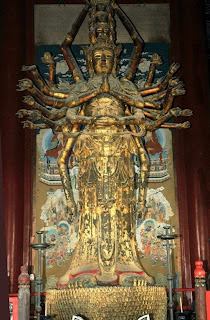
This tower is pretty impressive, three stories tall, with eight open sides to expose beautiful views in every direction. A statue of the Thousand Handed (Guanshiyin) Buddha is at the center, with a giant pearl hanging from the apex of the ceiling above its head(s). The gold gilding literally glows in the late afternoon sun, exuding a mystical quality of its own.
I can’t find anything that explains how the gold stayed in tact, since this dates back to the Ming Dynasty, long before Allied soldiers began scraping gold off the gold gilded cauldrons of the Forbidden City with their bayonets.
Chalk that up to another Chinese mystery.
(Photo credit: Vilas, from Picasa)
 Tuesday, May 6, 2008
Beijing
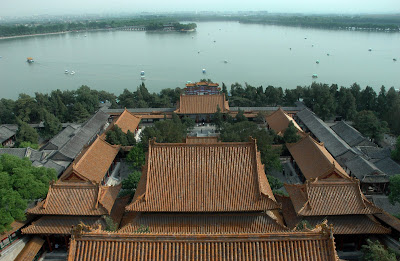
Yes. Definitely worth the long, painful hike up. Just look at this view.
The main Palace complex is below, with Kunming Lake beyond it. You can see the myriad of ferry boats between the shore and South Lake Island, where visitors go to see the Temple of the Dragon King.
Beijing lays in the far distance.