Forbidden City

Dragon Spouts

by Cinda Baxter on May 5, 2008

in Beijing, Forbidden City, Travel

Monday, May 5, 2008
Beijing

Before leaving home, Jennifer asked me to find the downspouts in the Forbidden City and photograph them—she’s in the midst of fine tuning the new house plans and is considering a similar idea for her rain garden. So off I go, shooting a zillion shots of these regal creatures. They’re everywhere, on every terrace, and every wall. And they’re fabulous.

So here you go, Jenn. Design away.


{ 0 comments }

One Supreme Courtyard

by Cinda Baxter on May 5, 2008

in Beijing, Forbidden City, Travel

Monday, May 5, 2008
Beijing

Looking back into the courtyard I just crossed, it’s hard not to be impressed by the history of this place. Here, I’m looking at the Pavilion of Spreading Righteousness, on the west side. Today, it houses an exhibition of Qing Dynasty court music.

There’s no racing across the grounds without caution, though, unless a twisted ankle is your goal. With six hundred years of feet, horses, carriages, and carts ahead of you, the best plan of attack is to look down, step, look up, gawk, look down, step, look up, gawk….

{ 0 comments }

Harmony…not.

by Cinda Baxter on May 5, 2008

in Beijing, Forbidden City, Travel

Monday, May 5, 2008
Beijing

I can’t believe my eyes.

This happened in Rome, when I rounded a corner to find the much sought after Trevi Fountain shrouded in green baggies and hurricane fencing.

It’s happening again. I’ve traveled half way around the world to find the Hall of Supreme Harmony—the largest, most spectacular of the Forbidden City palaces—in the same condition, draped in sheets of plastic, caged in bamboo scaffolding.

Bummer………..

{ 0 comments }

Nine by Nine

by Cinda Baxter on May 5, 2008

in Beijing, Forbidden City, Travel

Monday, May 5, 2008
Beijing

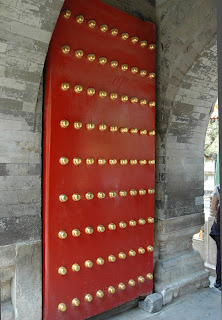
As long as we’re talking about repeated patterns, let’s look at the number nine again. Throughout the city, each significant “gate” consists of huge red double doors that swing open to the next courtyard. And each of those doors have eighty-one brass “nails” (the size of grapefruits in the Forbidden City), lined up nine across by nine down.

Numbers are a big deal in China, especially:

2 – Double symbols frequently appear in the Chinese culture—double happiness, double coins, double elephants. The phrase “Good things come in pairs” originated in China.

6 – When pronounced in Mandarin, sounds much like the words for “flowing” or “slippery.” Think: Everything goes smoothly. Even though western Christian cultures consider 666 a sign of the devil, it’s just the opposite in China. They see it as triple-loaded luck. According to news reports, a license plate sporting “AW6666” sold for a whopping $34,000 US to a motorcycle dealer in the Guangzhou provence. (Makes that vanity plate of yours look paltry now, huh?)

7 – Symbolizes togetherness. Also symbolizes the ultimate tragic separation between lovers, according to the tale of the Cowherder and the Weaver Girl, whose Romeo and Juliet-like tale ends in their spirits only being able to reunite on the seventh day of the seventh month (The Night of Sevens)…every 1,000 years. For that reason, seven is also considered sad, tragedy ridden, unlucky, and supernatural.

8 – In China, eight sounds similar to “prosper,” “wealth,” and “fortune,” depending on the dialect. Throw in the natural symmetry of the digit, then write two side by side, and you get “shuang xi,” or “double joy.” The phone number 8888-8888 sold for $ 270,723 US in the Chengdu provence. The Olympic Games open on 8.8.08. A fish breeder in Singapore who deals in rare Asian Arowanas embeds the creatures with microchip tag numbers, reserving those loaded with lots of 8s and 6s for the most valuable of the bunch.

Then there’s nine. Lucky number nine. Fabulous number nine.

Oh yeah. Including antechambers, there are exactly 9,999 rooms in the Forbidden City. And that’s only because in Chinese culture, heaven alone has 10,000 rooms.

It’s the nines, baby.

{ 0 comments }

Creatures Great and Small

by Cinda Baxter on May 5, 2008

in Beijing, Forbidden City, Travel

Monday, May 5, 2008
Beijing

The rooftops of the various gates and palaces throughout China are adorned with creatures—similar to those on the rooftops of the Po Lin Monastery on Lantau Island in Hong Kong. The more creatures, the more significant the building, with a max of nine (there’s that number again), flanked by two important figures—an immortal riding a phoenix at the front of the line, symbolizing the Empress; a dragon at the end symbolizing the Emperor.

This is the lineup on top of the Gate of Supreme Harmony. There aren’t a lot of buildings that get more creature-heavy than this.

{ 0 comments }

Gate of Supreme Harmony

by Cinda Baxter on May 5, 2008

in Beijing, Forbidden City, Travel

Monday, May 5, 2008
Beijing

The Gate of Supreme Harmony marks the entrance to the second portion of the Outer Court, where the most well known image of the Forbidden City reigns from a mountain of marble tiers—the Hall of Supreme Harmony. But not yet.

In the bright sunlight of Beijing, the golden rooftops glow, each one painted in a high gloss yellow—the color of the royal family. The deep reds of the walls signify happiness and auspiciousness, while the vivid blues are a reflection of the heavens (remember the Temple of Heaven’s blue rooftops yesterday?). The overall effect is one of hyper-technicolor imagery, right there in front of the naked eye. Each building and gate is truly a spectacular vision.

{ 0 comments }

Golden Water

by Cinda Baxter on May 5, 2008

in Beijing, Forbidden City, Travel

Monday, May 5, 2008
Beijing

In the next several posts, I’m going to walk you through the Forbidden City, beginning with the five marble bridges crossing the Jinshui Creek (better known as “Golden Waters”). The creek runs from west to east, in a gently curving path that mimics the jade belts worn by court officials.

Why five? To symbolize the five cardinal virtues of Confucius:

Jen – Benevolence, sympathy and perfect virtue in personal interactions
Yi – Sense of duty or responsibility
Li – Manners, propriety, good form, and the rituals governing social relationships*
Chih – Wisdom, reflected in a sense of right and wrong
Hsin – Good faith, trustworthiness, and loyalty

* Also known as the Emily Vanderbuilt Virtue (well, at least in my world)

That big building in the background? Our next stop, the Gate of Supreme Harmony. We can’t go inside, since it’s under renovation, though. Now through 2020, each of the palaces and gates are being buffed and polished, so it’s gonna be a while before all the construction walls and tarps are gone.

Hey, no sweat. It would be different if the entire thing was under plastic. Still looks gorgeous to me.

{ 0 comments }

Passing Through the Meridian

by Cinda Baxter on May 5, 2008

in Beijing, Forbidden City, Travel

Monday, May 5, 2008
Beijing

The Meridian Gate is the true entry point to the Forbidden City‘s Outer Court, where ceremonial events occurred. It was from the sky-high balconies that the Emperor would review his armies and announce the new lunar calendar on the Winter Solstice. Basically, it’s the pulpit from which he ruled the world as they knew it.

Today, it symbolizes the barrier between chaos and castles.

First stop: The ticket windows to the right of the five entry arches. The line moves quickly, provided you can fight your way through the entrepreneurial “guides” (see previous post). Apparently, the ticket window is the land of last chances; they know if they don’t snag a naïve tourist here, there are no more shots. They latch on, and don’t let go, no matter how many times you insist “No, no, no.” It got so bad that I finally began pretending I didn’t speak English. Of course, that didn’t stop one particularly rabid fellow from whipping out “I’ll be your guide” in French, just in case.

Second stop: The audio guide window, across the courtyard, to the left of the arches. Since both the entry and audio tickets are purchased at the ticket window, you trot over here next, stand in line at the window on the right, then exchange your audio ticket for a flat digital unit that hangs around your neck (in the language of your choice). Next, you move three feet to your left, to the next line, where you get the headphones and a 3-second explanation of its use.

Third step: Head to the arch immediately to the right of the audio booth. Get in the security line. Place your bags and cameras on the x-ray machine band (think: security at the airport), give them your ticket, then pass to the other end of the band where you pick up your items. Pretty simple. Pretty understandable.

Fourth step: Turn around, face into the Outer Courtyard and gasp with the realization that you’re actually standing here. In the Forbidden City. In Beijing.

Holy cow.

{ 0 comments }