 Monday, May 5, 2008
Beijing
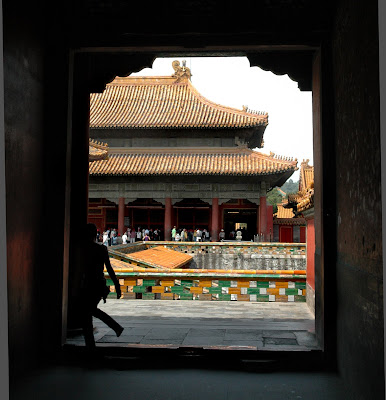
Each of the red double doorways marked with 9×9 gold nail heads is constructed with a high threshold—to get to the next courtyard or hall, you have to climb over the barriers that can run from a couple of inches tall to nearly a foot. The higher the step, the more important the passageway or gate.
As a sign of respect, one is not to step on the threshold, but over it, as it symbolizes the shoulders of the person inhabiting that hall.
If there‘s any place else on earth more steeped in respect and dignity, I can’t imagine where it is. Entering the Inner Court, you practically feel the heavy robes of history carefully draping over your own shoulders.
 Monday, May 5, 2008
Beijing
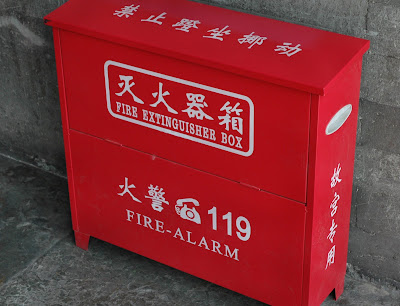
Somehow, I don’t get the feeling fire prevention has come a long way quite yet.
 Monday, May 5, 2008
Beijing
The Hall of Preserving Harmony marks the transition from the ceremonial Outer Court to the private Inner Court where the Emperor and his family actually lived. This smaller courtyard is a kind of “no man’s land” between home and the rest of the world.
On the back (north) side of the Hall of Preserving Harmony, there’s an intricately carved ramp flanked by two sets of steps, traversing the entire ninety-eight feet from the ceremonial hall platform to the “floor” of the Inner Court. In these carvings, dragons chase pearls through the clouds in an etherial image of the Emperor in the heavens. Only the Emperor himself was allowed to use this ramp (carried on platforms, the carriers using the steps on either side). This ramp is the largest in the Forbidden City, and is truly a sight to behold.

 Monday,
May 5, 2008
Beijing
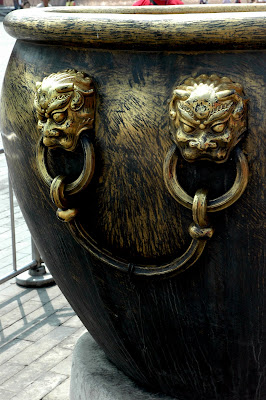
As mentioned before, there are bronze cauldrons sprinkled all over the Outer Court, for the purpose of dealing with fires (remember, these buildings are constructed from ancient wood). The cauldrons closest to the Hall of Preserving Harmony are the most impressive thus far, but show scars of heartaches past.
See the scratch marks? They aren’t from careless bumping or normal wear and tear, but from the bayonets of Allied soldiers during the occupation of Beijing, used to scrape the gold gilding off the bronze as part of their personal plundering.
Sometimes, war creates more casualties than we realize.
 Monday, May 5, 2008
Beijing
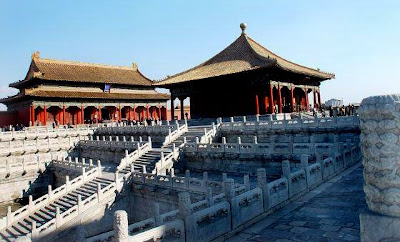
Behind the Hall of Middle Harmony (right) stands the third Ceremonial Hall of the Outer Court, the Hall of Preserving Harmony (left). The entire complex of three ceremonial halls is perched atop a three-tiered platform of white marble that raises them a dizzying ninety-eight feet in the air, with steps cascading downward on all sides.
Originally used for banquets, later (as in a few hundred years, but what’s a century or two between friends?) it was better known as the Palace of Examination where the country’s best scholars would take the Highest Level of Imperial Exams in the Nation, hopeful they’d advance to the ultimate rank of “Jin Shi.”
And I thought the Minnesota driver’s license test was a stinker. Who knew?
(Photo credit: ChinaReport.com)
 Monday, May 5, 2008
Beijing
Behind the Hall of Supreme Harmony there are two more ceremonial halls—the small, square Hall of Middle Harmony (foreground) and the larger Hall of Preserving Harmony. The former is the smallest of the three halls in the Outer Court, in sharp contrast to the preceding Hall of Supreme Harmony from where I just came, which is by far, the largest.
For a little hall, this one’s worn a lot of monikers: The Hall of Middle Harmony, The Hall of Balancing Harmony, The Hall of Complete Harmony, The Hall of Central Harmony, and The Hall of Medium Harmony. During the Ming Dynasty, this was where the Emperor received High Officials in private before proceeding to official grand ceremonies.
 Monday, May 5, 2008
Beijing
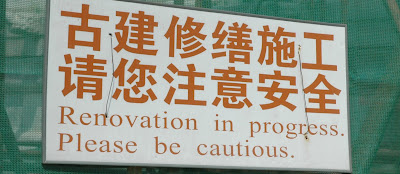
Just in case you didn’t notice the miles of plastic sheeting and bamboo scaffolding that hid the entire Hall of Supreme Harmony….
 Monday, May 3, 2008
Beijing
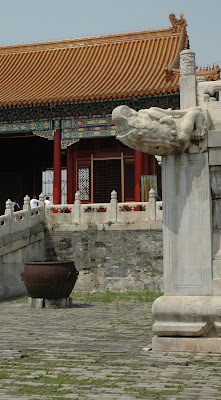
Flanking either side of the Hall of Supreme Harmony are enormous bronze cauldrons. These, along with dozens of others like them, were kept filled with water in case of fire—pretty important, since the neighboring hall is the largest wooden structure in the China, the center of the Forbidden City, and home to the Imperial Dragon Throne, the seat of the Chinese Empire.
To prevent the winter from freezing in the cold Beijing winters, cauldrons were lined with cotton pads, covered with lids, then heated by open flames from below.