Monday, May 5, 2008
Beijing
Before taking another step, you need to wrap your head around the hierarchy of gates, palaces, courtyards, and creatures here. The Forbidden City is, indeed, a city within a city, surrounded by sky-high fortress walls. Within that area are sub-sets of gates and palaces. As you move from the southern, more public end of the property toward the northern end that’s anchored by the Imperial Garden, you pass through a number of “gates,” or dividing line fortress walls that protect each new layer of intimacy.
The first courtyard you enter, between the Tiananmen Gate and the Meridian Gate isn’t actually a part of the Forbidden City at all, but merely an entrance to the Imperial Grounds, which explains the endless hawkers, kitch stands, ice cream carts, and carnival atmosphere that swirls around you in hyperactive speed. It’s nearly impossible to walk twenty paces without yet another entrepreneurial “guide” offering his services for a price.
Needless to say, not the experience I expected. Looks like once I pay for my entry ticket into the City, then pass through the Meridian Gate, the touristy sales stuff will vaporize.
Of course, not until after the entrepreneurs have had one last shot at all but tackling you to the ground as you pass through the ticket line.
Oh yeah. One other thing to wrap your head around. As recently as 1908, when the last Emperor ascended to the thrown, two months shy of his third birthday (yup…something else to wrap your head around), there were no “real men” allowed to live within the Forbidden City walls. Pretty much had to be one of the eunichs to get that p.o. address.
Yeeeeouch.
 Monday, May 5, 2008
Beijing
Entering the Tiananmen Gate (translated: Gate of Heavenly Peace) that leads to the Forbidden City, you’re met with two familiar sights—the 2-ton portrait of Chairman Mao gazing over Tiananmen Square from on high, and the boy soldiers who stand rigid guard around him day and night. The painting, which is actually a more flattering portrait than the original dour image that hung there first, has been in place for over fifty years (sans its annual cleaning on the eve of National Day, when a copy temporarily hangs in its place).
The baby-faced soldiers surrounding the gate look barely old enough to have facial hair, and stand as erect and still as stone. Not even as much as a blink.
The juxtaposition between youth and age with Tiananmen laid out just behind you is enough to make your head swim. Pretty potent stuff.
 Monday, May 5, 2008
Beijing
There’s a massive boulevard separating Tiananmen Square from the Forbidden City called Dong Chang’an Jie (at least that’s what it’s called in this section; street names tend to change every 100 yards, it seems). By massive, I mean 12+ lanes wide—with very little allowed traffic. There’s logic of some sort there; just don’t know what it is.
Anyway, taxis aren’t the only ones barred from this stretch—so are pedestrians. That, I understand. Halfway through your hike across the zip-code-wide roadway, you’d be stranded between green lights with no median for safe harbor. 43rd Avenue at Times Square looks like a quick hop compared to this.
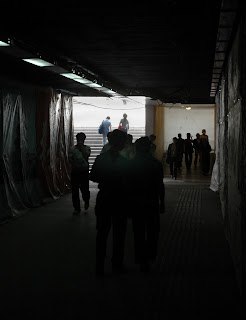
To move crowds from point A to point B, a system of angular tunnels criss-crosses below the pavement, connecting Tiananmen to the South Gate. The trek is made in nearly complete darkness with florescent lighting is so dim that seeing more than fifteen feet ahead verges on the impossible, even after your eyes adjust. Pretty hard not to feel a little vulnerable during the inevitable 2-block haul back to the surface.
At one turn, I nearly bump headlong into three uniformed guards stationed at the corner. Even close up, my first impression is that these waxy figures are statues symbolizing the nearby police academy.
Imagine my reaction when one blinked.
Decided not to take a photo. Something tells me it’s not on the “approved list” down here. Time to find the sunlight and move along.
 Monday, May 5, 2008