 Monday, May 5, 2008
Beijing
After parking myself on a nearby bench outside the Forbidden City to read my map and eat my ice cream, I decide transportation is going to be necessary to reach the next stop—having walked the length of the City, I now have a better handle on the scale of this place. Definitely a bigger area than I first thought.
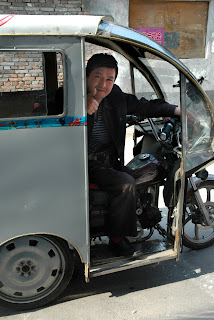
For some reason, the one thing that seems to be absent from the boulevard that borders the north end of the complex (Xianmen Dajie -or- Wenjin Jie -or- Jing Shan Qian Jie -or- Wusi Dajie, depending on which map or twelve-foot stretch you happen to be standing on) is a taxi. But…there are a bunch of little “put puts,” or motorized tricycles around (think: a three-wheeled motorcycle with a boxed single seat on the back). Oh yeah. The motorcycle’s at least vintage 1940.
What the heck.
Jump in. Hang on. We’re off.
Monday, May 5, 2008
Beijing
There’s something ironic about the audio set return booth being located at the Gate of Loyal Obedience.
Anyway, I returned the set, got my 100 RMB (yuan) deposit back, then started shuffling things around in my shoulder bag so the long trek to my next stop would be easier. Grabbed an ice cream bar at the little cart outside the gift store…
…and decided there’s something about Communist countries that equates to rock-your-world frozen dairy products.
Back in ’76 when I was visiting Russia as a high school kid, we were faced with what one might call “really bleak options” for breakfast (ie, sardines and milk that was actually thick). Learned pretty early on to grab fruit wherever we went, but still, needed more.
Then, one day in Leningrad (St. Petersburg), we stumbled across an ice cream cart. And nirvana.
I don’t know if it’s less pasteurization or heavier cream, but once again, I’ve found it—ice cream redefined.
 Monday, May 5, 2008
Beijing
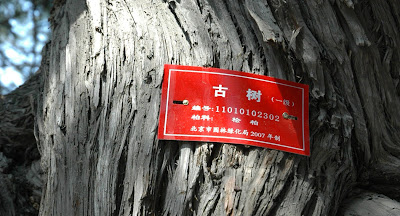
One of the things Holly pointed out yesterday was a system of tagging ancient trees with metal plaques that identify them by age. You can imagine how many of these tags are scattered around in a garden that’s existed for over 600 years. The two that seemed to be everywhere were green (100-300 years old) and red (300+ years old)—mostly the latter of the two.
If only we westerners valued age as much as the easterners do. In so many ways.
 Monday, May 5, 2008
Beijing
After passing through the three palaces of the Inner Court (that’s kind of a misnomer, since you can only walk around them, not through them), you come to one last gate—very small and very subtle, compared to the grand porticos I’ve stepped through thus far. The Gate of Heavenly Unity is the back door that leads to the family gardens.
Or, in this case, the Imperial Gardens, which are significantly more impressive than most families’ back yards.
Directly in front of me, as I step through the gate, are two ancient cypress trees intertwined as a symbol of eternal, devoted love. Even the most hard hearted cynic can’t help but look at these with awe. Surrounded by songbirds and spackled sunshine, one can only imagine the mystical, magical strolls taken by regals and royals. Today, those paths are ours to follow, with respect.
 Monday, May 5, 2008
Beijing
The Palace of Earthly Tranquility, where the Empress lived.
(Photo credit: igougo.com)
 Monday, May 5, 2008
Beijing
The Palace of Heavenly Purity—home to the Emperor.
(Photo credit: Picasaweb.Google.com)
 Monday, May 5, 2008
Beijing
The Inner Court consists of three halls, from south to north, as I walk through them:
The Palace of Heavenly Purity comes first, and is where the Emperor lived. As representative of Yang and the Heavens, this was the single most important hall in the Inner Court.
The Palace of Earthly Tranquility comes last, at the north end of the trio, and was the home of the Empress, who represented Yang and the Earth.
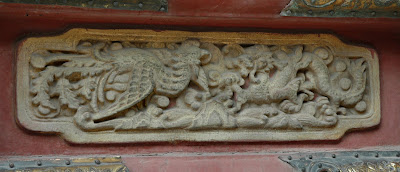
The small building in the middle, The Hall of Union, is just what it sounds like—the place Yin and Yang would meet to produce harmony (intricate carvings on the exterior feature the Imperial Dragon and the Phoenix, symbolizing the Emperor and Empress) . Today, the twenty-five Imperial Seals of the Qing Dynasty are stored, along with other ceremonial items and the official palace clocks.
Compared to the three halls in the Outer Court, the three Inner Court halls are much smaller, but make no mistake—they’re large and grand by anyone’s standards.
 Monday, May 5, 2008
Beijing
See…? Everywhere. Here, this is one of two stone lions guarding a mysterious door to a mysterious stone outbuilding. It’s tucked below the steps heading east from the south platform of the Palace of Heavenly Purity. No mention of it on the audio guide, no sign of it on the myriad of maps I have. Just a mysterious little shack that earned two Imperial lions.
Here, you see the female lioness with the cub playing beneath its paw. To its left was the other lion, complete with its orb.
Makes you wonder what’s behind door number one, hmm?
 Monday, May 5, 2008